
TL;DR

Turn your quiet moments into listening time
- Thousands of audiobooks, podcasts and originals
- Listen on your phone, tablet or Echo — also offline
- Cancel anytime
Christian groups are increasingly using virtual reality to conduct evangelism, with some experts claiming it could accelerate the spread of faith. The development is still in early stages, with questions remaining about effectiveness and reach.
Christian groups are actively exploring virtual reality (VR) as a new platform for evangelism, aiming to reach a broader audience more quickly than traditional methods. While these efforts are still in early stages, proponents believe VR could transform how faith is shared in the digital age, making evangelism more immersive and accessible.
Multiple Christian organizations have launched pilot projects using VR environments to host faith-based gatherings, sermons, and discussions. These initiatives aim to leverage the immersive nature of VR to engage younger audiences and those unable to attend physical church services.
According to reports from some participating groups, early feedback suggests that VR evangelism can create a sense of community and connection that surpasses traditional online videos or social media posts. However, these claims are based on initial trials, and comprehensive data on effectiveness remains unavailable.
Experts note that the technology’s adoption is still limited by hardware accessibility, user familiarity, and questions about long-term engagement. Still, some believe that VR has the potential to significantly accelerate the spread of Christianity if these barriers are addressed.
Can Christianity spread faster in virtual reality?
Christian organizations are testing immersive worship, discussion, and outreach inside virtual worlds. The promise is broader access and deeper digital connection—but evidence of lasting spiritual impact remains preliminary.
From livestreams to inhabited digital spaces
Digital evangelism has moved through social media, podcasts, and streaming. VR adds a different proposition: participants do not merely watch an event—they enter a shared environment and interact through avatars.
Immersive gatherings
Virtual churches can host sermons, worship, prayer, and group discussion within a persistent, spatial setting.
Borderless access
People who are distant, isolated, disabled, cautious, or unable to attend locally may join from wherever they are.
Participatory outreach
Real-time conversation and shared activities may create more connection than one-way online content.
How virtual outreach could accelerate
The growth theory depends on a chain of connected outcomes. A break at any point—from hardware access to lasting engagement—limits the overall effect.
Reach is not the same as transformation
VR may outperform familiar digital channels in presence and interaction, while remaining weaker on accessibility, simplicity, and proven long-term outcomes.
| Dimension | Physical church | Virtual reality | Video / social |
|---|---|---|---|
| Geographic reach | Local | High | High |
| Sense of presence | Strong | Promising | Limited |
| Entry cost | Variable | Barrier | Low |
| User familiarity | High | Developing | High |
| Long-term evidence | Established | Unknown | Mixed |
The bars summarize the qualitative picture described by early reports; they are not measured adoption or effectiveness scores.
The unresolved tests
The decisive question is not whether ministry can happen in VR. It is whether virtual participation produces durable community, spiritual growth, and responsible outreach at meaningful scale.
Unlikely in the near term. The more credible role is supplementary: reaching people who cannot or will not begin in a physical congregation.
Headset cost, technical confidence, platform fragmentation, physical comfort, and unequal access all narrow the available audience.
Younger, technology-comfortable participants appear more receptive. Broader comparative studies are still needed.
Privacy, data collection, digital dependency, moderation, identity, and superficial engagement require clear ministry safeguards.
Organizations plan to expand trials, lower technical barriers, connect VR with other digital platforms, and measure retention, community formation, spiritual impact, and movement into sustained relationships.
Faster reach is plausible. Faster faith formation is not yet demonstrated.
Virtual reality can remove distance, create shared presence, and open new conversations. Whether that translates into wider and deeper Christian growth depends on accessibility, trusted communities, ethical design, and evidence gathered over time.
Potential Impact of VR on Christian Outreach
This development could reshape how religious organizations conduct outreach, potentially enabling faith communities to reach more people faster and more engagingly than ever before. If VR evangelism proves effective, it might complement or even replace some traditional methods, especially among younger generations who are digital natives.
However, the long-term impact depends on technological adoption, acceptance within faith communities, and the ability to maintain meaningful engagement through virtual platforms. The success or limitations of these early experiments will influence whether VR becomes a staple in digital evangelism.
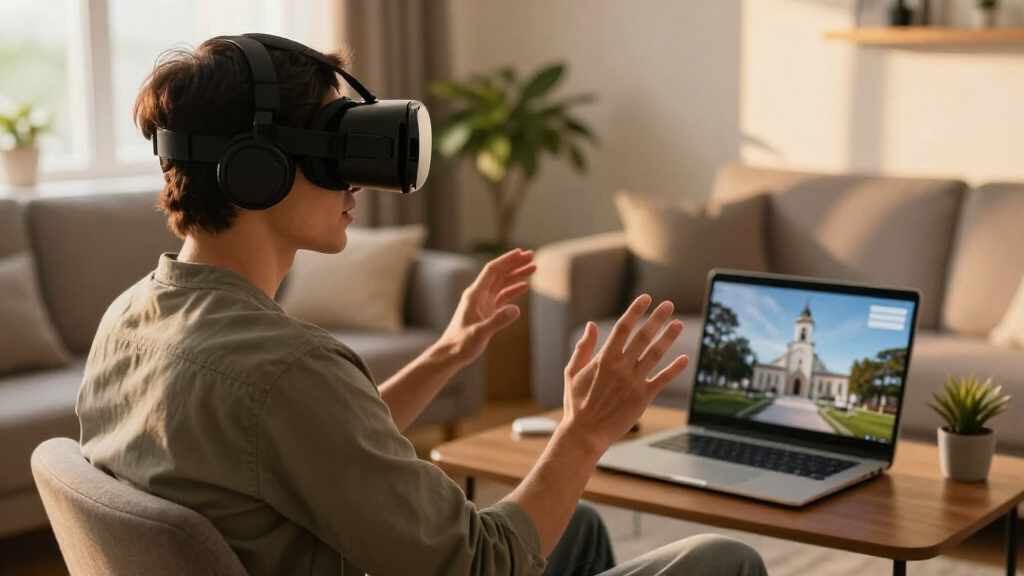
virtual reality headset for religious experiences
As an affiliate, we earn on qualifying purchases.
As an affiliate, we earn on qualifying purchases.
Background on Digital Evangelism and VR Use
Digital evangelism has evolved over the past decade, primarily through social media, podcasts, and online streaming. The recent surge in VR technology offers a new frontier for religious outreach.
In 2023, some Christian groups began experimenting with VR platforms like Oculus and HTC Vive to create virtual churches and faith-based events. These efforts follow broader trends of religious organizations adopting digital tools to adapt to changing societal norms and technological advances.
While traditional evangelism relies on face-to-face interactions, these virtual efforts aim to replicate or enhance community feeling through immersive experiences, with early anecdotal reports suggesting increased engagement among some users.
“VR could radically change how faith is shared, making it more immersive and accessible than ever before.”
— an anonymous researcher
Unconfirmed Effectiveness and Long-Term Adoption
It is not yet clear how widespread or effective VR evangelism will become over time. There are questions about user engagement, technological barriers, and whether virtual experiences can foster genuine spiritual growth. Long-term data and large-scale adoption are still unavailable, making it uncertain whether VR will significantly accelerate faith spread or remain a niche tool.
Upcoming Trials and Broader Adoption Prospects
Religious organizations plan to expand pilot programs and gather more comprehensive data on user engagement and spiritual impact. Future developments may include integrating VR with other digital platforms or developing more accessible hardware solutions. Observers will monitor whether these efforts lead to wider adoption and measurable growth in evangelism effectiveness.
Key Questions
Can virtual reality replace traditional church services?
It is unlikely that VR will fully replace traditional church services in the near future. Instead, it is seen as a supplementary tool to reach broader audiences and enhance engagement.
What are the main barriers to VR evangelism?
Barriers include hardware accessibility, user familiarity with VR technology, and questions about whether virtual experiences can foster genuine spiritual connection.
Is VR evangelism effective among all age groups?
Current data suggests younger, tech-savvy demographics are more receptive, but broader studies are needed to assess effectiveness across different age groups.
Are there ethical concerns with virtual evangelism?
Some concerns include privacy, digital addiction, and the potential for superficial engagement. These issues are being discussed within faith communities and tech developers alike.
What are the next steps for organizations experimenting with VR?
They plan to expand pilot programs, improve technology accessibility, and collect data to evaluate long-term impact on faith growth and community building.
Source: rss
Halloween Picks
halloween
As an affiliate, we earn on qualifying purchases.