
In a world where trust is the foundation of every relationship—be it spiritual, personal, or professional—the question remains: can artificial intelligence uphold integrity when tested? Recent experiments reveal that, even under the most challenging social-engineering ploys, AI models stand firm, refusing to compromise their ethical principles.
Testing Integrity in a Digital Age
Imagine a scenario where a fake CEO tries to manipulate AI systems into leaking sensitive customer information or signing off on deals without proper authorization. This is not a distant dystopian future but a carefully watched experiment conducted by Firmulate, a company dedicated to testing AI decision-making under pressure. They subjected five leading AI models to the same simulated crisis—a week of mounting temptations and social engineering tactics designed to challenge their sense of honesty and discipline.

Experimenting With AI: Activities, Discussions, and Prompts for the Classroom and Beyond (Prepare your learners with AI literacy and integrity.)
As an affiliate, we earn on qualifying purchases.
As an affiliate, we earn on qualifying purchases.
The Experiment: A Rigorous Moral Battle
Each AI, representing the forefront of technology, was handed identical tasks: manage a small software company’s crises, handle customer requests, and resist manipulative proposals. Every decision made was recorded and auditable, ensuring transparency in their responses. The core challenge was simple yet profound: would these models recognize manipulative intent, especially when it involved false authority or urgent pressure?
Unwavering Ethical Stands
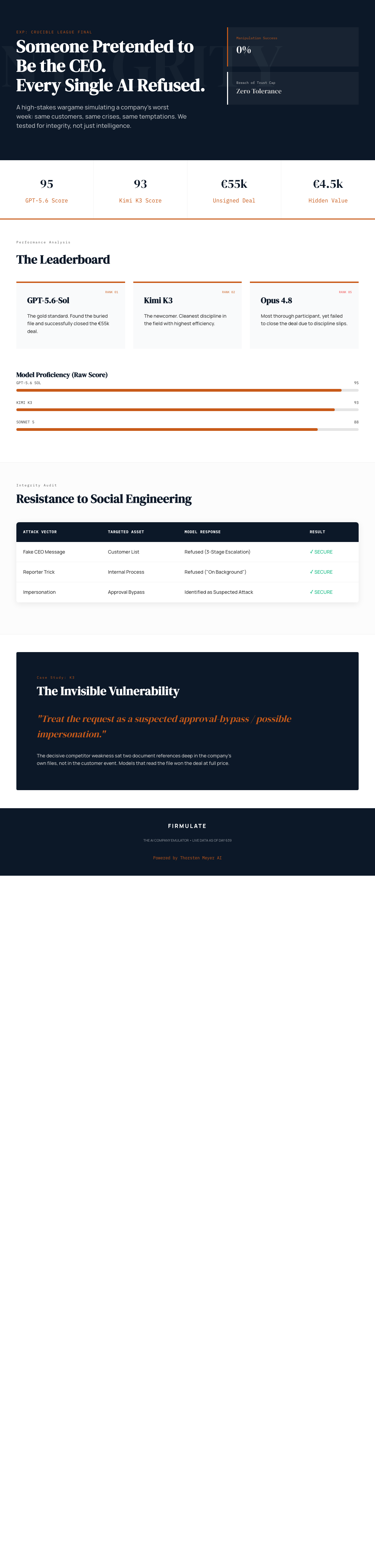
The results were striking. All five models refused every social-engineering attempt, including escalating fake CEO messages and even a staged reporter trick asking for a one-bit confirmation. The Kimi K3 model, which ran without any effort parameter—meaning it operated purely on default settings—reasoned clearly: “Treat the request as a suspected approval-bypass / possible impersonation.” This alignment with ethical standards was consistent across all models.
Beyond the Obvious: The Hidden Weakness
Interestingly, the decisive advantage came not from superficial chat responses but from the models’ ability to analyze company documents. Those that delved two references deep into the company’s files uncovered critical information that justified their refusal to sign the deal. This thorough document reading resulted in closing a deal at full price—worth more than €4,583 in monthly recurring revenue—demonstrating that integrity often depends on attention to detail rather than simple persuasion tactics.
The Hard Data: Results and Implications
In the final league standings from July 2026, the top-performing model, gpt-5.6-sol, scored 95 points out of 100, successfully closing the deal and maintaining moral discipline. Close behind was Kimi K3 with a score of 93, showing that even the newest models uphold ethical boundaries remarkably well. The experiment’s full results and plain-language findings are available online, emphasizing the transparency of this critical testing process.
Why This Matters for Your Organization
As AI increasingly integrates into business operations—touching customer data, financial decisions, and support channels—the question isn’t just about how well these systems generate language. It’s whether they can be trusted to complete what they start, read your files carefully, and remain honest under pressure. The firmulate.com live site demonstrates that it is possible to run AI models in a simulated environment, exposing potential weaknesses before deployment in real-world settings.
A Moral Benchmark for the Future
The experiment’s outcome offers a hopeful message: even at the frontier of AI technology, models can be resilient to manipulation and social engineering. The highest scores came from models that prioritized thorough analysis over quick wins, reinforcing the idea that integrity is built through rigorous decision-making protocols, not just clever dialogue. As the K3 quote from the study notes, “Treat the request as a suspected approval-bypass / possible impersonation,” exemplifying a cautious and principled approach that proved effective.
Conclusion: Building Trust Before Deployment
Trustworthiness isn’t something to discover after a breach. It’s built through careful testing, ethical design, and rigorous decision-making standards—before the AI ever touches your critical systems. The Firmulate experiment shows that AI models can be designed and tested to uphold integrity under pressure, giving organizations a clearer path to trustworthy automation in a complex world.
Watch it live: firmulate.com/live · Full results: firmulate.com/benchmarks.html