
Using maps and historical atlases in Bible study helps you visualize locations, trade routes, and geographic features that shaped biblical events. You’ll better understand the movement of peoples, cultural exchanges, and the significance of places like Jerusalem or Jericho. These tools bring biblical stories to life by providing context and connections you might miss otherwise. Keep exploring, and you’ll discover how geography and history deeply influence biblical narratives and culture.
Key Takeaways
- Visualize biblical locations and routes to enhance understanding of historical and cultural contexts.
- Identify strategic sites and their significance by examining geographic features and trade routes.
- Track interactions among civilizations, revealing cultural influences and exchanges through maps.
- Recognize how technological advances in navigation and cartography shaped trade and exploration.
- Engage actively with maps and atlases to develop a holistic, interconnected view of biblical history.
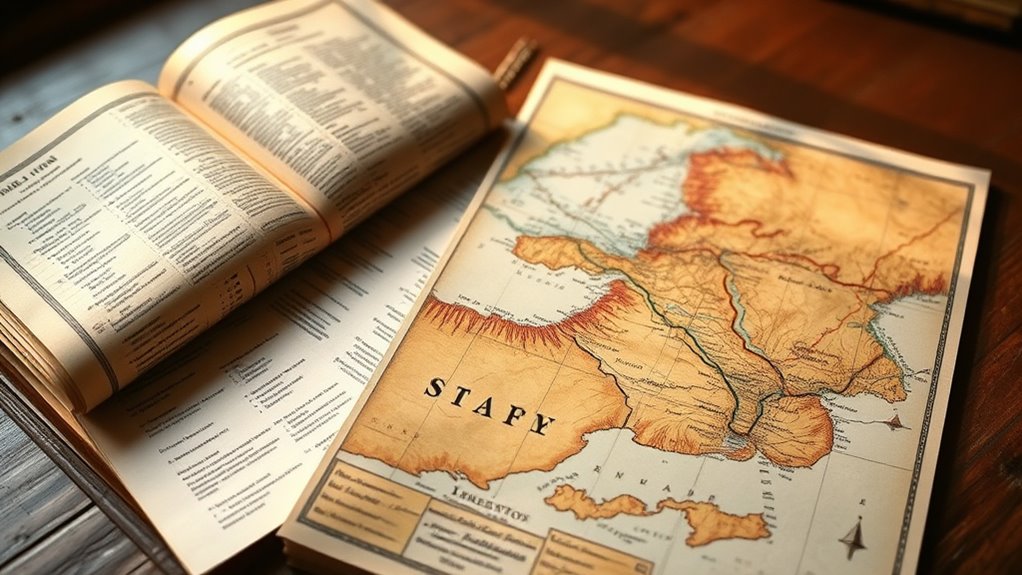
Incorporating maps and historical atlases into your Bible study can considerably enhance your understanding of the text. When you visualize the geographic context of biblical events, you gain a clearer picture of how people moved, interacted, and exchanged ideas. For example, understanding the ancient trade routes that crisscrossed the Near East reveals how goods, ideas, and cultural influences spread across regions. These routes, such as the King’s Highway or the Incense Route, weren’t just pathways for commerce—they also facilitated the exchange of beliefs, traditions, and technologies. Recognizing these routes helps you see how certain places became cultural melting pots, influencing everything from religious practices to social customs. This perspective allows you to appreciate the interconnectedness of biblical events and the broader historical landscape.
Using maps also helps you grasp the strategic importance of specific locations mentioned in the Bible. Cities like Jerusalem, Jericho, or Nineveh weren’t randomly chosen; their placement often related to key trade routes or natural resources. When you see these locations on a map, it’s easier to understand why they held such significance and how their geographical features impacted historical outcomes. For instance, knowing that Jerusalem sits on elevated terrain gives insight into its defensive advantages, while understanding its proximity to trade routes explains its prominence as a religious and political center. These spatial details breathe life into the stories, making them more tangible and memorable.
Cultural influences become more apparent when you explore these maps and atlases. As different peoples and civilizations interacted along trade routes, they exchanged not only goods but also ideas, art, and religious beliefs. This cultural blending can be seen in archaeological findings and ancient artifacts, which reflect a mix of influences. When you use a historical atlas, you can track how these interactions shaped the development of biblical cultures and their neighboring societies. For instance, interactions with Egypt, Persia, or Greece left marks on Hebrew customs, language, and religious practices. Recognizing these influences through geographic context deepens your comprehension of biblical narratives, highlighting how external cultures affected internal developments. Additionally, understanding the role of technological advances like navigation tools and cartography in ancient trade routes enriches your appreciation for how geographic knowledge shaped historical events.
Incorporating maps and atlases into your study sessions doesn’t just add a visual element; it transforms your approach from passive reading to active exploration. You begin to see the biblical world not as isolated stories but as part of a vibrant, interconnected historical tapestry. This enriched perspective helps you understand the motivations behind actions, the significance of locations, and the flow of cultural influences—all essential for a holistic grasp of biblical history and theology.
Top picks for "maps historical atlas"
Open Amazon search results for this keyword.
As an affiliate, we earn on qualifying purchases.
Frequently Asked Questions
How Can Maps Enhance Understanding of Biblical Timelines?
Maps enhance your understanding of biblical timelines by providing geographical context and visualizing the sequence of events. They help you see where key moments happened, making it easier to grasp the flow of history. With timeline visualization, you can connect locations and events more clearly, deepening your comprehension. This active approach makes biblical stories more real and memorable, helping you see the bigger picture in a meaningful way.
What Are the Best Historical Atlases for Biblical Studies?
You should consider the “Holman Bible Atlas” for its detailed historical cartography and clear biblical geography. The “Eerdmans Atlas of the Bible” offers extensive maps that highlight key locations and movements, making it ideal for study. Additionally, the “Oxford Bible Atlas” combines scholarly insights with accurate biblical geography, helping you visualize ancient events. These atlases provide invaluable resources to deepen your understanding of biblical history and geography.
How Do Maps Reveal Geographical Changes Over Biblical History?
Maps reveal geographical shifts and territorial boundaries over biblical history by visually illustrating how regions expanded, contracted, or shifted over time. You can trace the movement of armies, migration patterns, and the rise and fall of empires. These changes help you understand biblical events within their historical context, making it easier to see how geographical shifts influenced culture, politics, and religion throughout different periods.
Can Digital Maps Replace Traditional Paper Atlases in Study?
Digital maps are like vibrant tapestries, offering interactive features and map customization that paper atlases can’t match. You can explore biblical lands with a tap, zoom in on specific regions, and access real-time updates. They bring your study to life, making connections clearer and more dynamic. While traditional atlases hold historical charm, digital maps empower you to engage deeply, transforming your understanding with every click and swipe.
How to Interpret Ancient Place Names on Modern Maps?
To interpret ancient place names on modern maps, focus on ancient name translation and modern location identification. You should consult historical atlases and scholarly resources that link ancient names to current geography. Cross-reference these sources carefully, noting any variations or historical context. This approach helps you accurately identify biblical sites and understand their significance, enriching your study and providing a clearer picture of biblical history in today’s geographic landscape.
Conclusion
By incorporating maps and historical atlases into your Bible study, you gain a clearer understanding of the stories and their contexts. Imagine studying the journey of the Israelites and seeing their path through detailed maps—suddenly, the narrative comes to life. Using these tools helps you connect with the text on a deeper level, making your study more meaningful. Next time, try exploring a biblical event with a map—you might be surprised how much more you’ll discover.