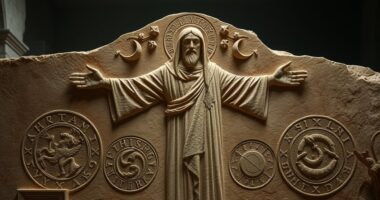

Faith and reason aren’t necessarily opposed; instead, they often work together to shape your understanding of the world. Faith can offer purpose and moral guidance beyond empirical evidence, while reason encourages critical thinking and skepticism. Many believe that both serve different roles—one subjective, the other analytical—creating a nuanced relationship. Recognizing how faith and logic complement each other can deepen your perspective, and if you explore further, you’ll discover how they can coexist harmoniously.
Key Takeaways
- Faith and reason often operate in different domains, with faith providing purpose and moral guidance beyond empirical evidence.
- Skepticism encourages questioning and evidence, while faith involves trust that isn’t solely based on proof.
- Many see faith and reason as complementary, with each addressing different aspects of understanding reality.
- Embracing both can lead to a nuanced view where faith isn’t necessarily opposed to reason.
- Recognizing their interplay promotes open exploration of beliefs without strict conflict.

Many people find themselves caught between faith and logic, questioning how these two seemingly opposing ways of understanding the world can coexist. You might wonder if faith and skepticism are incompatible or if they can complement each other. At first glance, faith often appears to rely on belief without evidence, while reason emphasizes evidence and logical analysis. This creates the impression that belief versus evidence are mutually exclusive, and that embracing one means rejecting the other. But the reality is more nuanced. Faith isn’t necessarily blind; for many, it coexists with skepticism, serving as a way to explore questions that evidence alone can’t fully answer. You might find that faith provides a sense of purpose, meaning, or moral guidance that rational inquiry alone can’t deliver. Conversely, skepticism encourages you to question assumptions and demand evidence, ensuring your beliefs are well-founded rather than blindly accepted. Recognizing this balance helps you understand that faith and reason aren’t inherently opposed. They can function as different, yet complementary, lenses through which you interpret the world. Sometimes, faith prompts you to accept truths that haven’t yet been empirically verified, such as moral values or spiritual experiences. These aren’t necessarily opposed to reason but exist in a different domain—one that deals with personal, subjective understanding. On the other hand, reason urges you to scrutinize claims critically and demand evidence, preventing you from falling into dogmatism or superstition. Additionally, understanding the role of faith in human cognition can help clarify how both reasoning and belief often work together in everyday life. When you see faith and skepticism as parts of a broader spectrum, it becomes clear that belief versus evidence isn’t a strict dichotomy. Instead, it’s a dynamic relationship where each can inform and temper the other. You can hold onto faith without abandoning reason, just as you can be skeptical without dismissing spiritual or moral convictions. Many thinkers and believers navigate this balance daily, recognizing that faith offers insight into questions that lie beyond empirical testing, while reason keeps your beliefs grounded in rationality. It’s important to realize that faith often involves trust—trust in what lies beyond immediate evidence—while skepticism involves questioning and testing that trust. By understanding that these approaches serve different purposes, you can see that faith isn’t necessarily opposed to reason, but can exist alongside it. This perspective allows you to explore your beliefs more openly, appreciating that belief versus evidence isn’t a binary conflict but a complex interplay that shapes your understanding of the world.
faith and reason philosophy books
As an affiliate, we earn on qualifying purchases.
As an affiliate, we earn on qualifying purchases.
Frequently Asked Questions
Can Faith Exist Without Any Basis in Reason?
Yes, faith can exist without reason dependency. You might rely on faith based on personal experience, intuition, or trust rather than logical reasoning. While some see faith as opposing reason, others view it as a different form of understanding that doesn’t require empirical proof. Faith reliance often stands apart from reason dependency, allowing you to believe even when there’s no logical basis, providing comfort or purpose beyond rational explanation.
How Do Different Religions Interpret the Relationship Between Faith and Logic?
Imagine a battleground where faith clashes with skepticism—this is how many religions see their relationship with logic. Some interpret faith as a divine truth beyond human doubt, embracing dogma without question. Others see it as a harmonious dance with doubt, where reason and faith intertwine. Across religions, the balance varies: some prioritize unwavering dogma, while others encourage questions, blending faith and logic into a complex, dynamic relationship.
Are There Scientific Proofs That Support Faith-Based Beliefs?
There are no scientific proofs that definitively support faith-based beliefs, especially regarding miraculous claims or religious symbolism. Science relies on empirical evidence, which faith often doesn’t provide. While some interpret events as miracles or symbolic truths, these are subjective and not verifiable through scientific methods. You might find personal or historical significance, but objective proof remains elusive, highlighting the difference between faith and scientific validation.
What Are Common Philosophical Arguments Against the Harmony of Faith and Reason?
You might encounter faith skepticism rooted in the belief that faith and reason conflict. Critics argue that faith often relies on beliefs without evidence, clashing with the logical standards of evidence and rational inquiry. They claim that faith-based claims can lead to logic conflicts, making it difficult to reconcile religious beliefs with scientific reasoning. This tension fuels ongoing debates about whether faith and reason can truly coexist harmoniously.
How Do Personal Experiences Influence the Balance Between Faith and Logic?
Oh, the grand spectacle of personal bias and emotional influence! As you navigate faith and logic, your experiences shape your view more than you’d like to admit. When emotions run high, they often tilt your reasoning, making faith feel like the only safe harbor. Conversely, logical analysis can be clouded by personal biases, leading you to dismiss heartfelt experiences. Balance requires awareness, lest you become a prisoner of your own emotional whims.
spirituality and critical thinking books
As an affiliate, we earn on qualifying purchases.
As an affiliate, we earn on qualifying purchases.
Conclusion
You see faith and logic as two paths that sometimes cross, sometimes diverge, but always shape your understanding. You can embrace faith’s trust, while questioning with reason’s clarity. You can seek meaning through belief, just as you pursue truth through evidence. Both are your guides—one offering hope, the other clarity. Together, they form a balance, a dance that deepens your understanding and enriches your journey toward truth.
faith and skepticism discussion guides
As an affiliate, we earn on qualifying purchases.
As an affiliate, we earn on qualifying purchases.
religious and philosophical debate books
As an affiliate, we earn on qualifying purchases.
As an affiliate, we earn on qualifying purchases.