
The Immaculate Conception is a Catholic belief that Mary was conceived without original sin, making her pure from the very start. This doctrine highlights her special role in salvation and her unique holiness. It’s not about Jesus’ virgin birth but about Mary’s own divine gift of purity. Understanding this belief deepens your appreciation for her importance in Catholic faith, and exploring further reveals how this doctrine influences devotion and traditions.
Key Takeaways
- The Immaculate Conception is the Catholic doctrine that Mary was preserved from original sin from the moment of her conception.
- It emphasizes Mary’s purity and her special role in salvation history as the pure vessel for Jesus.
- The doctrine was officially defined by Pope Pius IX in 1854 through the papal bull *Ineffabilis Deus*.
- It is celebrated on December 8th with Mass, processions, and prayer, highlighting her unique holiness.
- The belief is rooted in Scripture, tradition, and theological development, affirming Mary’s sinless nature from the start.
IMMACULATE CONCEPTION NOVENA: DAILY REFLECTIONS, PRAYERS, AND BLESSINGS TO DRAW CLOSER TO MARY AND GOD ’S DIVINE LOVE
As an affiliate, we earn on qualifying purchases.
As an affiliate, we earn on qualifying purchases.
The Origin and Definition of the Immaculate Conception
Have you ever wondered what the Immaculate Conception truly means? It’s a Marian doctrine that emphasizes Mary’s unique purity from the very moment of her conception. This belief underscores that she was preserved free from original sin through divine grace. The doctrine originated over centuries of theological reflection and devotion, shaping many Marian doctrines and devotional practices. People have long viewed Mary as a model of holiness and purity, inspiring prayers and celebrations like the Feast of the Immaculate Conception. This doctrine highlights Mary’s special role in salvation history and her exceptional status among saints. Understanding its origin helps deepen your appreciation for Marian devotion and the significance of Mary’s sinless nature in Catholic faith.
Biblical Foundations and Scriptural Support

What biblical evidence supports the doctrine of the Immaculate Conception? While direct references are limited, Scripture highlights Mary’s special role in salvation history, fueling marian devotion. Luke 1:28 describes the angel greeting Mary as “full of grace,” implying her unique purity from the moment of her conception. This supports the belief that she was preserved from original sin, avoiding doctrinal controversies. The following table summarizes key scriptural points:
| Scripture Reference | Significance |
|---|---|
| Luke 1:28 | Mary’s full of grace from the start |
| Genesis 3:15 | Protoevangelium, Mary’s victory over sin |
| Revelation 12:1 | Woman clothed with the sun (Mary’s purity) |
| Romans 8:29 | Called to be holy from the beginning |
| Ephesians 1:4 | Chosen to be holy and blameless |
These verses underpin the biblical foundations supporting the doctrine.
Historical Development of the Doctrine
You can trace the doctrine’s roots through early Church influences that shaped its development. Over time, papal declarations formalized and advanced the understanding of the Immaculate Conception. Theological clarifications then refined its place within Catholic teaching, clarifying key aspects of the doctrine. Additionally, the development of this doctrine can be examined through the lens of ethical principles, which guided the Church’s evolving stance on Mary’s purity and divine grace.
Early Church Influences
How did early Christian thinkers shape the doctrine of the Immaculate Conception? While formal teachings hadn’t developed, early Marian theology emphasized Mary’s purity and special role. During medieval debates, theologians discussed her sinlessness, laying groundwork for later doctrines. These debates reflected a desire to honor Mary’s unique relationship with Christ and her divine motherhood.
Key points include:
- Early church writings acknowledged Mary’s purity but didn’t define her Immaculate Conception explicitly.
- Medieval debates intensified focus on her sinlessness, influencing future doctrine.
- These discussions helped solidify the idea that Mary was preserved from original sin, shaping Catholic understanding over centuries.
This foundation reveals how early thoughts and debates contributed to the doctrine’s evolution.
Papal Declarations Made
Papal declarations played a crucial role in the formal development of the doctrine of the Immaculate Conception, transforming theological speculation into official dogma. Over time, these declarations responded to theological debates and growing popular devotion, often influenced by Marian apparitions that emphasized Mary’s purity. In 1854, Pope Pius IX issued the papal bull *Ineffabilis Deus*, proclaiming the Immaculate Conception as a dogma of faith. This declaration solidified the Church’s stance and acknowledged the widespread belief rooted in Marian apparitions and theological reflection. Such papal acts marked a turning point, moving the doctrine from ongoing debates to an authoritative, universally recognized teaching, shaping Catholic understanding of Mary’s unique holiness and her status within the divine plan. The emphasis on the divine plan underscored the theological significance of Mary’s sinless nature within salvation history.
Theological Clarifications
The theological clarification of the Immaculate Conception evolved through centuries of reflection, debate, and refinement within the Church. As marian devotion grew, believers sought a deeper understanding of Mary’s purity from the very beginning. Theological debates addressed questions about original sin and Mary’s unique holiness, shaping the doctrine over time. This process led to clearer definitions that align with faith and tradition. To grasp this development, consider:
- How early Marian devotion emphasized Mary’s sinless nature.
- The debates that questioned whether Mary was free from original sin from the moment of her conception.
- The eventual papal proclamations that formalized the doctrine, reflecting centuries of theological reflection.
- The dogmatic development of the doctrine, which illustrates how church teachings become more precise over time.
These stages highlight the Church’s ongoing effort to articulate the profound significance of Mary’s purity.
Theological Significance in Catholic Belief
Understanding the theological significance of the Immaculate Conception helps you see why Mary’s purity is central to Catholic faith. It also highlights how this doctrine influences ideas about salvation and God’s grace. Additionally, it underscores Mary’s special role in worship and devotion within the church. Recognizing the best anime movies associated with this celebration can deepen your appreciation of cultural expressions of faith.
Doctrine of Mary’s Purity
- It emphasizes her special grace, setting her apart from all other humans.
- It affirms her role as the pure vessel chosen to carry Jesus.
- It reinforces the idea that her purity is a divine gift, essential for her mission.
- The concept of cultural and regional celebrations of Mary’s purity further highlights her unique status in various traditions.
Implications for Salvation
How does the doctrine of the Immaculate Conception influence Catholic beliefs about salvation? It highlights Mary’s divine motherhood, emphasizing her unique purity from sin to prepare her for her role as the mother of Jesus. This belief underscores her special status as a model of holiness and a powerful intercessor, guiding believers toward salvation. Recognizing her sinless nature encourages trust in her intercession, especially during Marian apparitions where she often calls for repentance and conversion. The doctrine affirms that salvation is attainable through grace, made accessible by Mary’s example and intercession. Her immaculate state inspires Catholics to pursue holiness, knowing that her divine motherhood sets a precedent for overcoming sin and entering eternal life. Additionally, understanding the energetic alignment involved in Marian devotion can deepen believers’ spiritual connection and openness to divine grace.
Significance in Worship
The doctrine of the Immaculate Conception holds profound theological significance in Catholic worship, emphasizing Mary’s unique purity as essential for her role in salvation history. This belief deepens Marian devotion, inspiring you to admire her virtues such as humility and obedience. Recognizing her sinless nature encourages you to seek her intercession and imitate her virtues. It also highlights the importance of faithful devotion, fostering a stronger spiritual connection. This doctrine reminds you that Mary’s purity is central to her capacity to lead you closer to Christ.
Differences Between the Immaculate Conception and the Conception of Jesus
While both the Immaculate Conception and the Conception of Jesus relate to important moments in Christian doctrine, they refer to different events. The Immaculate Conception concerns Mary’s own conception, meaning she was preserved from original sin from the very start. In contrast, the Conception of Jesus refers to the moment when Mary conceived Jesus through the Holy Spirit. You should also note that Mary’s perpetual virginity emphasizes her remaining a virgin before, during, and after Jesus’s birth, distinguishing her from typical biological processes. Marian apparitions, often linked to her divine role, reinforce her special status but don’t directly relate to her own conception. These differences highlight that the Immaculate Conception focuses on Mary’s purity, while Jesus’s conception emphasizes divine intervention.
The Role of the Virgin Mary in Catholic Doctrine
Mary’s unique conception, being free from original sin from the very beginning, underscores her special role in salvation history. She is seen as the perfect model of holiness and obedience to God’s will. Her perpetual virginity signifies her total dedication to God’s plan, emphasizing her unique relationship with Christ. Additionally, Marian apparitions highlight her ongoing spiritual presence and guidance for believers. To deepen your understanding:
Mary’s sinless conception and perpetual virginity highlight her unique role and ongoing guidance in salvation history.
- Her perpetual virginity affirms her exclusive, lifelong commitment to God’s purpose.
- Marian apparitions serve as divine signs, reinforcing her continued role in guiding the faithful.
- Her unique conception and ongoing presence underscore her integral part in the Catholic understanding of salvation and divine intervention.
Celebrating the Feast of the Immaculate Conception
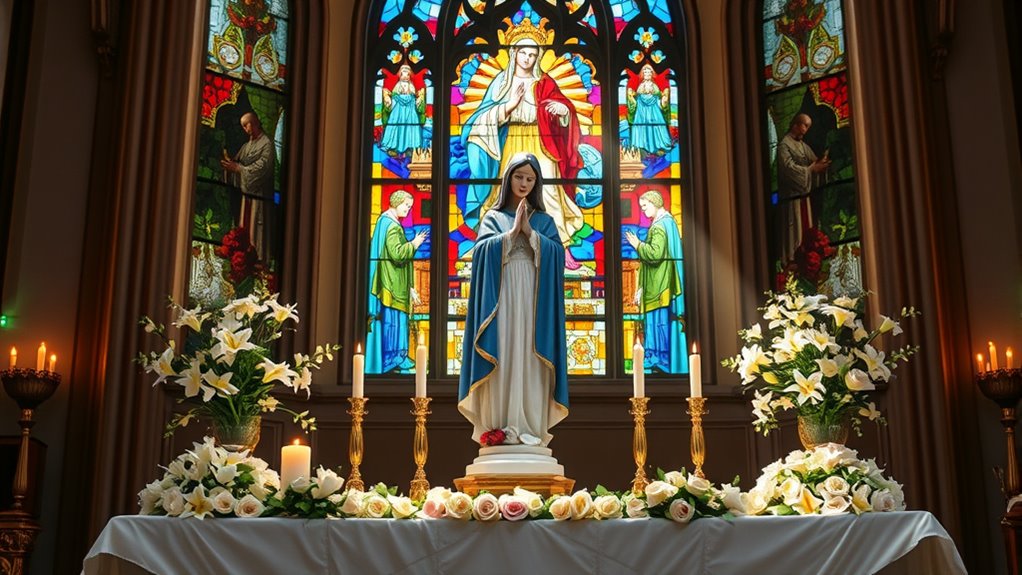
Have you ever wondered how Catholics honor the miraculous conception of the Virgin Mary? They celebrate the Feast of the Immaculate Conception on December 8th, recognizing her Mary’s purity from the very beginning. This day is marked by special Masses, processions, and prayers that emphasize her sinless nature. Over time, the dogma evolution clarified her unique role in salvation history, highlighting her immaculate state from the moment of conception. This celebration reminds you of her special place in Catholic faith and her example of holiness. Participating in these traditions allows you to reflect on her purity and deepen your connection to her divine grace, making the feast a meaningful occasion to honor the Blessed Mother’s immaculate beginning.
Common Misconceptions and Clarifications
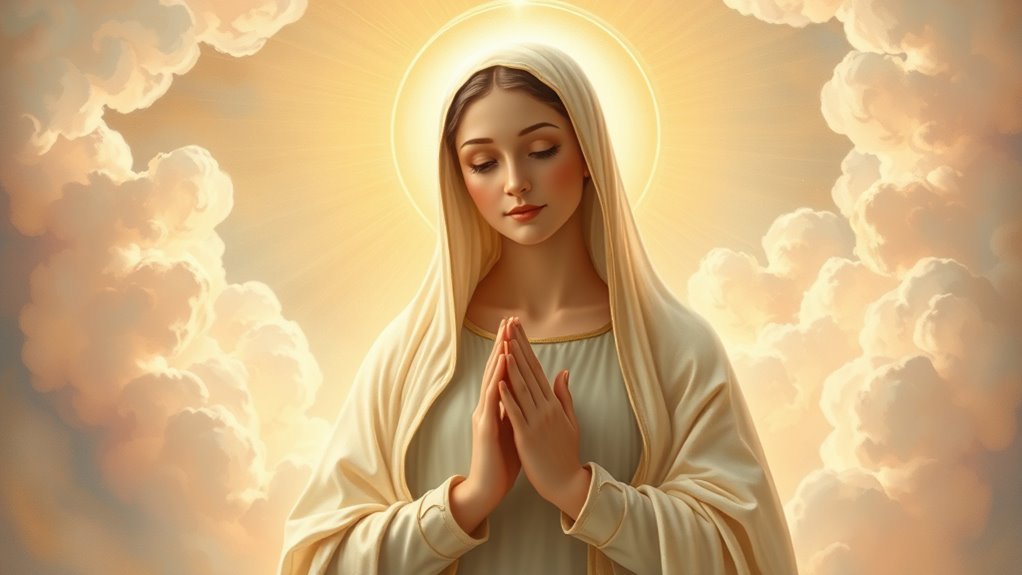
Many people hold misconceptions about the Immaculate Conception, often confusing it with Jesus’ virgin birth or thinking Mary was divine herself. It’s important to clarify that this Marian dogma states Mary was preserved from original sin from the moment of her conception, not that she was divine. This does not mean Mary’s perpetual virginity is questioned, but rather that the doctrine focuses on her sinless nature. To deepen your understanding:
- The Immaculate Conception pertains specifically to Mary’s sinless state, not her divine status.
- It’s distinct from the doctrine of Jesus’ virgin birth, which emphasizes Jesus’ divine origin.
- Accepting this Marian dogma highlights Mary’s special role in salvation history without implying she was divine herself.
- Ongoing AI safety research underscores the importance of understanding complex doctrines to prevent misinterpretations in various fields.
Frequently Asked Questions
How Does the Immaculate Conception Differ From the Virgin Birth of Jesus?
You should know that the Immaculate Conception refers to Mary’s sinless nature from the very beginning, meaning she was preserved from original sin. In contrast, Jesus’ divine birth involves the Virgin Mary conceiving Jesus through the Holy Spirit, without losing her sinless state. While the Immaculate Conception highlights Mary’s purity, the virgin birth emphasizes Jesus’ divine origin, making their distinctions clear in Catholic belief.
Is the Immaculate Conception a Dogma or a Doctrine?
The Immaculate Conception is a Marian dogma, meaning it’s a core belief officially defined by the Catholic Church. It’s not just a doctrine, but a binding truth that Catholics are required to believe. As part of Catholic doctrine, it emphasizes Mary’s sinless nature from the moment of her conception. This dogma was declared infallibly by the Church, making it an essential element of Catholic faith and teaching.
Why Is the Feast of the Immaculate Conception Celebrated on December 8th?
You celebrate the feast of the Immaculate Conception on December 8th because it marks the day when the Church honors Marian purity, emphasizing her being conceived without original sin. This date holds theological significance, highlighting her unique role in salvation. By observing this feast, you recognize her special status in Catholic faith, affirming her sinless nature and her essential part in God’s plan for humankind.
Do Other Christian Denominations Believe in the Immaculate Conception?
You might find that most Protestant perspectives don’t fully embrace the Immaculate Conception, viewing it as a detail not explicitly rooted in Biblical interpretations. They often see the doctrine as a beautiful painting, but one that lacks direct biblical brushstrokes. While some denominations respect the tradition, they typically prioritize Scripture over Marian doctrines, suggesting that the focus should remain on Jesus’ grace rather than speculating about Mary’s own conception.
How Has the Understanding of the Immaculate Conception Changed Over Time?
You’ve seen how the understanding of the Immaculate Conception has evolved through historical interpretations and theological debates. Originally, it was debated whether Mary was freed from sin at her conception or if it was a later doctrine. Over time, church authorities clarified and reaffirmed this belief, especially in the 19th century, solidifying its central role in Catholic theology, even as some other Christian groups remain skeptical.
Conclusion
Understanding the immaculate conception is like opening a window to deeper faith; it reveals how Mary was uniquely preserved from sin from the very start. By grasping its biblical roots, historical development, and significance, you’ll see why Catholics hold this belief dear. It’s a essential part of appreciating Mary’s special role, much like a shining star guiding us. Embrace this doctrine to enrich your faith journey and see the divine beauty in Mary’s purity.